© 2026
Strategy Game Studio / Avalon Digital · 18 Apr 2024
Sign in to rate this game in seconds.
English, French, Spanish - Spain, Simplified Chinese, German, Polish, Portuguese - Portugal, Russian, Vietnamese
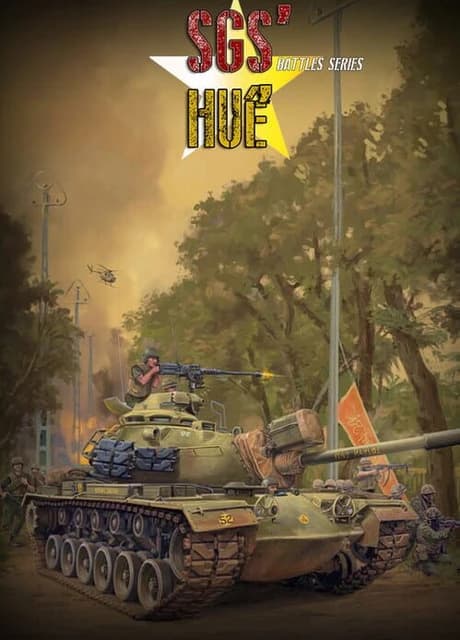
The battle of Hué is an epic fight during the audacious 1968 Tết offensive launched by the Communists during the Vietnam War. Relive one of the longest, bloodiest battles the Americans would fight against VC in that emblematic conflict.
SGS Hué is the third game of our SGS Battle Series, covering intense fights and battles in well know (or not) small but fighting-heavy locations ; ‘grand’ tactical’ scale for regiment, battalion, company and even platoon-size units (depending on the games) and game turns which represent a very short real period of time (one or two days, half a day, a few hours…).
The Battle of Hué took place from January 30 to March 3, 1968, as part of the Tet offensive launched by the North Vietnamese Army and the National Front for the Liberation of South Vietnam (better known as the Viet Cong) in early 1968. This confrontation was one of the longest and bloodiest of the Vietnam War, both in urban areas (in various parts of the city of Hué) and in more peripheral rural areas.
Hué, the former imperial capital of Vietnam, straddles Route 1, some 100 km south of the DMZ (demilitarized zone) and some 10 km west of the coast. With around 140,000 inhabitants, it was South Vietnam's third-largest city in the 1960s. The tragedy of Hué in 1968 was exacerbated by its glorious past: fierce fighting took place in narrow streets, in more modern sectors with buildings transformed into fortresses, amidst ancient monuments...
Hué's past as an imperial capital - a symbol for Vietnam - its political and cultural importance, its demographic importance and, last but not least, its geographical location make it a strategic target for both the NVA and the Viet Cong.
SGS Battle for Hué recreates this battle on a "grand tactical" scale. Counters represent companies, platoons, sections and even groups/squads, while a game turn corresponds to one day of real time. Turn-based play allows you to face off against the AI, another player in a "hot seat" or via PBEM. Both sides ("Free World" and "Communists") are playable.
A campaign scenario lets you simulate the entire battle. A number of smaller scenarios are also available, and several more will be added after the game's release. The campaign scenario thus sees the use of around 500 counters, for a game lasting several hours (manual saves possible at any time in the game, in addition to automatic saves), to a few dozen counters in the more modest scenarios.
In the campaign scenario, the Communist player must seize as many sectors of Hué and the surrounding area as possible (to ensure the supply and reinforcement of units in the city's districts), then hold them for as long as possible. The longer the North Vietnamese/Vietnamese-Cong player holds on with symbolic points, the greater his chances of victory.
For the Free World player, on the other hand, it's a case of first resisting the enemy offensive, then racing against the clock to regain lost ground as quickly as possible.
Players have to balance their strengths and weaknesses, with the added constraints of complex terrain to tackle: dense urban areas, military installations, villages, rice paddies... Each of these terrains has its own modifiers (influencing movement and combat) which can make offensive operations particularly tricky unless actions are organized by combining the strengths of the units involved.
The "Free World" forces are heterogeneous:
Communist forces are more homogeneous, but while their overall morale is excellent (it can drop towards the end of the campaign):
The player must learn how best to combine his forces so that they support each other in detailed battle phases. For example, an infantry company on its own will be doomed to failure without the support of other units. For example, the Marines' M48A3 tanks are invaluable in attracting enemy fire, enabling the infantry to lead the assault with considerably reduced losses. In contrast to the Americans, diminished Viet Cong units see their mobility increase, making them more difficult to annihilate.
The game includes various support units, CS gas attack counters and sniper elements (which prevent total control of a sector until they have been eliminated or driven out). Patrols can appear as reinforcements, certain command units can trigger mortar/artillery fire,
No reviews yet. Be the first to share your thoughts!
Write a ReviewNo discussions yet. Be the first to start a conversation!